
Flexible LED Modules — Soft LED Module Wholesale
A soft module is what you buy when the wall is not flat. The PCB, the silicone back shell and the mask all bend, so the panel follows a column, an inner arc or a wave instead of fighting it — and it sticks to a steel frame with magnets, no cabinet.
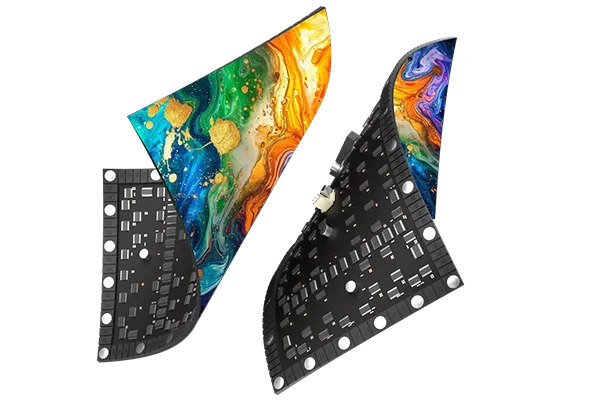
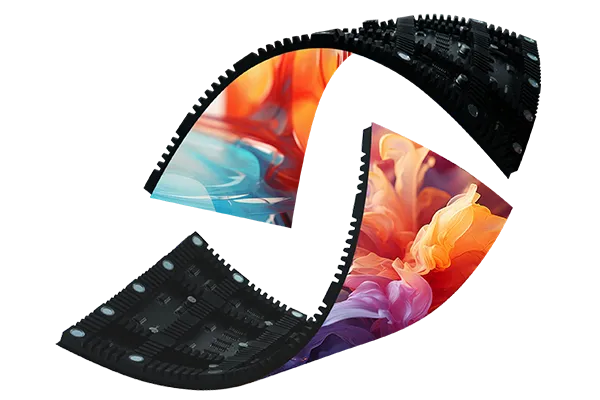
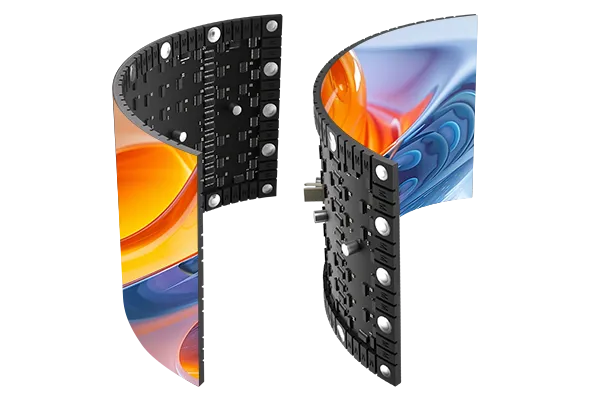
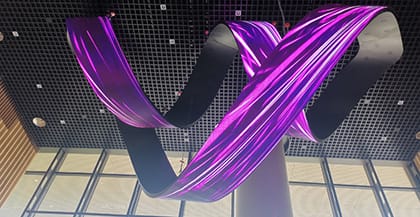
WCIMCI supplies flexible (soft) LED modules from P1.25 to P4 in 240×120, 320×160 and 256×128 mm, with magnetic front service, 3,840 Hz refresh and 16-bit grey. Minimum order is 1 m². A 240×120 module bends to roughly 760 mm diameter and a 320×160 to roughly 815 mm; indoor modules are IP30–IP31 at 800–1,000 nits, outdoor builds use IP65 potting. Radius and viewing distance decide the pitch and the module count.
A flexible LED module is built on a flexible PCB with a soft silicone base and mask, instead of the rigid plastic shell of a standard panel. That lets it bend to a concave, convex, cylindrical or S-shaped frame. Strong magnets on the back hold it against a custom steel structure, so there is no cabinet: the module comes off from the front with a suction cup, which is the only practical way to service a curved wall once it is installed.
Three footprints cover almost every job. 240 × 120 mm is the workhorse and carries the full P1.25–P4 range; 320 × 160 mm suits P1.86, P2, P2.5 and P3.076 where fewer seams matter; 256 × 128 mm is common on P2 and P4 and on sealed outdoor versions. A 240 × 120 module bends to roughly 760 mm diameter, a 320 × 160 to roughly 815 mm. Tighter than that and the corner LEDs start lifting off the PCB, so we split the arc into more, smaller modules rather than forcing the bend.
For wholesale orders the pitch is only half the decision. Send the radius and the closest viewing distance and we will match the pitch, the module size, the magnet layout and the spare ratio to the frame. Indoor modules run 800–1,000 nits at 3,840 Hz with 16-bit grey; outdoor builds get IP65 potting on both faces. Everything is aged 72 hours before crating, and we ship modules, receiving cards, power supplies and a mapped spare kit together so the installer is not left waiting on one missing part.
Where this line usually goes
- Column wraps and cylindrical pillars
- Concave and convex feature walls
- Wave, ribbon and S-shaped screens
- Spheres, domes and curved ceiling details
- Retail atriums, brand activations and shop windows
- Stage sets, exhibition stands and museum objects
Send the radius, not the pitch
Most enquiries open with a pixel pitch. The number that actually decides whether the build works is the radius of the curve: at 400 mm radius a 240 × 120 mm module is already close to its limit, while a 1,500 mm column can take almost any of them. Give us the radius and the closest viewing distance and we will send back the pitch, the module size, how many modules the arc needs and where the seams will fall.
Flexible LED Modules models
Stock configurations below. Any diameter, outline or pitch is quoted from your file.
Standard pitches and module sizes
These are the configurations we quote every week. The figures below are typical industry values for indoor soft modules; the datasheet issued with each batch carries the actual LED lot, IC and measured brightness.
A pitch is not tied to one footprint. P2 and P2.5 both run in 240 × 120 mm and 320 × 160 mm, and the choice is usually about seam count on the finished curve rather than about resolution.
The 320 × 160 mm footprint is the thin, high-magnet-count panel — about 4.8 mm thick, 26 magnet points, GOB coating as standard — and it is the one that bends to a full 90°. The 240 × 120 mm footprint is the lighter, higher-resolution panel used when the curve is gentle and the viewing distance is short.
| Pitch | Module size | Pixels / module | LED | Brightness | Where it gets used |
|---|---|---|---|---|---|
| P1.25 | 240 × 120 mm | 192 × 96 | SMD1010 | 600–700 nits | Close-view fine pitch |
| P1.5625 | 200 × 150 mm | 128 × 96 | SMD1212 | 700–900 nits | Fine-pitch variant |
| P1.579 | 240 × 120 mm | 152 × 76 | SMD1212 | 700–900 nits | Retail close viewing |
| P1.667 | 240 × 120 mm | 144 × 72 | SMD1212 | 700–900 nits | 2K-friendly layouts |
| P1.875 | 240 × 120 mm | 128 × 64 | SMD1212 | 800–1,000 nits | Most requested pitch |
| P2 | 240 × 120 / 320 × 160 mm | 120 × 60 / 160 × 80 | SMD1515 | 1,000 nits | Column workhorse |
| P2.5 | 240 × 120 / 320 × 160 mm | 96 × 48 / 128 × 64 | SMD1515 | 800–1,000 nits | Atriums and retail |
| P3 | 240 × 120 mm | 80 × 40 | SMD2121 | 1,000 nits | Larger curves |
| P3.076 | 320 × 160 mm | 104 × 52 | SMD1515 | 800–1,000 nits | Fewer seams |
| P4 | 240 × 120 / 256 × 128 mm | 60 × 30 / 64 × 32 | SMD2121 | 1,000 nits | Outdoor sealed option |
Refresh 3,840 Hz (7,680 Hz on selected drivers), 16-bit grey, 140°/140° viewing angle, front magnetic service. GOB coating and a soft mask are available on selected pitches.
Each pitch gets its own page in the catalogue with the full electrical and mechanical drawing. Until then, ask for the spec sheet by pitch and we will send the current revision.
How a soft module order is specified
- 01
Fix the radius first
The curve decides which footprint will survive. Below roughly 760 mm diameter we split the arc into smaller modules or more segments instead of over-bending one panel.
- 02
Set the pitch from viewing distance
A 2 m viewing distance usually lands on P1.875–P2.5; 5 m and beyond moves to P3–P4. Brightness follows the ambient light, not the pitch.
- 03
Draw the frame and the magnet layout
The modules stick to a steel frame, so the frame drawing is part of the order. We mark magnet positions, cable runs and the service side before anything is cut.
- 04
Agree spares, mapping and the crate
A spare ratio, the receiving-card map and the crate type are fixed before production. Modules, power, cables and spares ship together.
What is in a wholesale shipment
- Flexible LED modules, batch-matched for colour and brightness, 72-hour aged
- Receiving cards, power supplies, HUB75 cables and a connection map for the frame
- A spare kit at the agreed ratio, from the same LED and IC lots as the order
- Optional GOB coating, soft mask, IP65 potting and pre-bent steel frame
- Plywood crate or flight case, with EXW / FOB Shenzhen / CIF / DDP terms
Tell us the radius, the viewing distance and how many square metres the frame takes. Those three numbers are enough to come back with a pitch, a module count and a price.
Outdoor flexible modules
Outdoor soft modules are a different build from the indoor line. The board runs a higher drive current and a weatherproof lamp (SMD2727 / 3535), the mask and the flex harness are potted, and the whole module carries IP66 so rain and dust sit on the surface instead of reaching the solder joints.
The standard outdoor footprint is 256 × 128 mm (the same size listed by mydled and other makers as their outdoor MS series), quoted in P4 / P5 / P6 / P8 from 4 m out to street scale. Where a tighter radius is needed, 320 × 160 mm modules form the inner arc and 256 × 128 mm panels form the outer arc of the same cylinder.
Front magnetic service still applies, so a panel comes off the steel frame with a suction cup exactly like the indoor version. The only differences are the seal and the brightness, which runs 4,500–6,000 nits to stay readable in direct sun.
Flexible LED Modules questions
Three that come up on almost every flexible enquiry. Ask us anything else directly.
What is a flexible (soft) LED module?
Which module size do I need for a column?
Do you sell loose modules or complete screens?
Can flexible modules be used outdoors?
What is the lead time and how is it packed?
Tell us the radius and the area.
Pitch, module size, bend radius and square metres are enough to price a flexible module order. If you have no pitch in mind yet, send the viewing distance instead and we will pick one for you.
Flexible LED Modules enquiry
We reply within one working day. Drawings can follow by email.
Tell us the size and the viewing distance.
Those two numbers decide the pitch, the cabinet count and most of the price. Send them and we will come back with a build.
