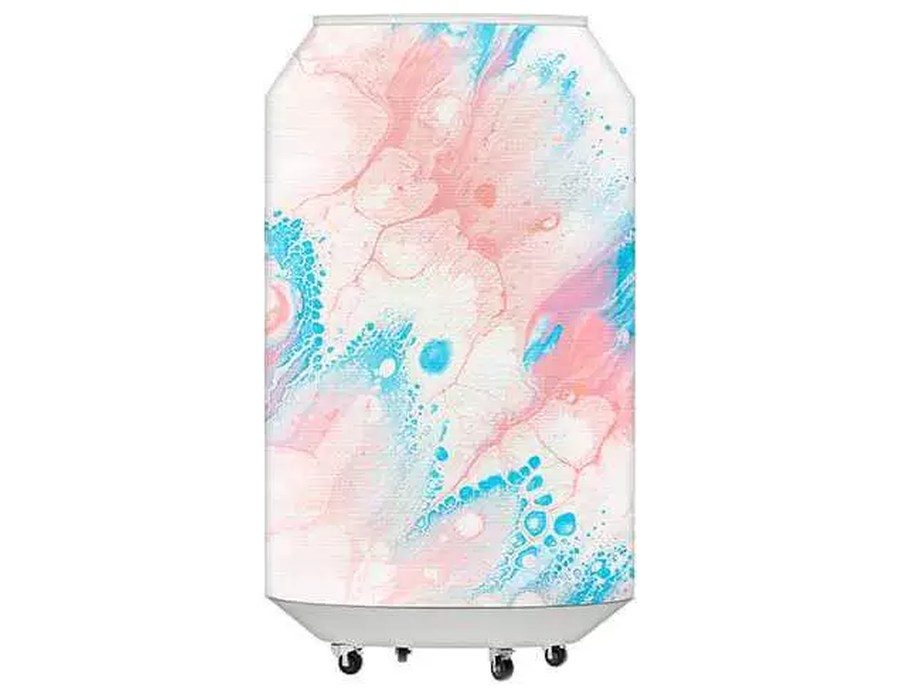
600 mm LED Can Display — Counter and Bar Top
A 600 mm barrel 1,100 mm tall, built from eight identical curved segments: 2.07 m² of screen, 519,200 lit pixels at P2 and 27 kg without the plinth.
- 8 at 45° each
- 519,200 at P2
- 2.07 m²
Every can screen is a cylinder with a lid, and the lid is the cheap part. What you pay for is the segments the diameter forces — eight at 600 mm, twenty at 1.2 m.
A can LED display is a cylinder built to packaging proportions, split into whole identical segments: an 800 mm barrel at 1,500 mm tall is 3.77 m² of screen, 1,092,936 lit pixels at P1.86, 49 kg, and twelve segments at 30° each. Height ÷ diameter of 1.875 is what makes it read as a 330 ml can rather than a pillar — at 600 mm the same proportion would be only 1,110 mm tall.
A cylinder is the simplest curved form we build, which is why the price surprises people. It is not the surface that costs money: it is that the ring has to be cut into a whole number of identical segments, and that number is set by the diameter rather than by the area. Two barrels with the same square metres can differ by a third in price because one needs eight moulded parts and the other needs twenty.
The geometry is unforgiving in the opposite direction to intuition. A 500 mm barrel has to bend its arc 37 mm to follow the curve, which is beyond what a flexible module tolerates; a 1,500 mm barrel only bends 6.4 mm and is nearly a flat panel. So the small can is the engineering problem and the large one is a logistics problem — twenty segments do not fit through a 900 mm door.
What almost nobody puts in the quote is the shoulder: the taper between the body and the lid. On a real can it happens over 15 mm; scaled up twelve times it is a compound curve at a radius too tight for any standard module, so it either becomes a lit strip build at a fifth of the barrel price, or a static spun closure. We settle that in the first drawing rather than the third invoice.
Most can enquiries arrive as a diameter, because a diameter is what fits on the drawing. The number that decides whether the object reads as a can or as a pillar is the ratio of height to diameter, and it comes from the packaging: 1.85 for a 330 ml can, 2.55 for a 500 ml, 2.53 for a 250 ml sleek. Send the height you have available and we will send back the diameter that holds the proportion. At 1,500 mm tall a can proportion of 1.85 needs 811 mm across — not 600, and not 1,000.
Stock configurations below. Any diameter, outline or pitch is quoted from your file.

A 600 mm barrel 1,100 mm tall, built from eight identical curved segments: 2.07 m² of screen, 519,200 lit pixels at P2 and 27 kg without the plinth.

800 mm across, 1,500 mm of screen: 3.77 m², twelve segments at 30°, 1,092,936 lit pixels at P1.86 and 49 kg.

A 1,200 mm barrel, 2,200 mm tall, twenty segments at 18°: 8.29 m² of screen, 1.32 M lit pixels at P2.5, 6.6 kW and 108 kg.

The other end of the line: a real can or bottle reproduced at one to six times life size, Ø200 to 600 mm and up to 1,800 mm tall, built from 80 mm wide modules because nothing standard will follow a 78.5 mm arc.
A can screen is a cylinder, and a cylinder is the easiest curved surface in the trade. What makes it expensive is that it has to be cut into an integer number of identical segments — the number of parts, not the number of square metres, is what comes back on the quote.
The constraint is geometric. A ring of diameter D is split into n segments, so each segment covers an arc of πD ÷ n. Bend that arc across a chord and the middle of the chord falls short of the curve by a sagitta of s = D/2 − √((D/2)² − (a/2)²). That shortfall is how far the module has to flex. Under about 20 mm the board is comfortable; past 30 mm the corner LEDs start to lift off the PCB at the solder joint, and the failure appears six months later as a column of dead pixels at the segment edge.
Which produces the counter-intuitive result below: the small barrels are the difficult ones. A 500 mm barrel needs 37 mm of sag across its arc, and there is no flexible module on the market that enjoys that. A 1,500 mm barrel needs 6.4 mm and is almost a flat panel. So the 600 mm model is the one where we have to be careful, and the 1.2 m model is the one where we have to be careful about packing.
Two consequences for anyone comparing quotes: first, a 600 mm barrel is not simply a 1.2 m barrel divided by four, because eight segments and twenty segments do not scale with area; second, a supplier who quotes a price per square metre for a can has either not costed the tooling or is planning to add it later.
| Diameter | Circumference | Segments | Arc per segment | Sagitta | Screen area | Max power |
|---|---|---|---|---|---|---|
| 500 mm | 1,571 mm | 6 | 261.8 mm | 37.0 mm | 1.45 m² | 1.2 kW |
| 600 mm | 1,885 mm | 8 | 235.6 mm | 24.1 mm | 2.07 m² | 1.7 kW |
| 800 mm | 2,513 mm | 12 | 209.4 mm | 14.0 mm | 3.77 m² | 3.0 kW |
| 1,000 mm | 3,142 mm | 16 | 196.3 mm | 9.7 mm | 5.81 m² | 4.6 kW |
| 1,200 mm | 3,770 mm | 20 | 188.5 mm | 7.4 mm | 8.29 m² | 6.6 kW |
| 1,500 mm | 4,712 mm | 24 | 196.3 mm | 6.4 mm | 13.08 m² | 10.5 kW |
Height fixed at 1.85 × diameter, the 330 ml can proportion. Segments chosen so no arc exceeds 262 mm. Sagitta is the bend, and it falls as the diameter grows — the opposite of what most people assume.
Everything above describes a straight barrel with a lid on it. A real can is not that: it tapers in at the top through a shoulder, and the shoulder is where the drawing stops being a cylinder and starts being a problem.
On a 330 ml can the shoulder runs from 66 mm down to the 52 mm lid over roughly 15 mm of height. Scale that up 12× and you are asking a flexible module to bend along two axes at once, around a radius that works out at 20 to 30 mm. Flexible modules have a minimum bend radius — 35 mm is realistic for anything with a 1515 lamp on it — so the shoulder cannot be covered in the same material as the body. The options are narrow strip modules cut to follow each latitude, a thermoformed shell with a printed graphic, or a spun aluminium shoulder finished to match the artwork.
This matters commercially because almost no quote includes it. The barrel is priced, the shoulder is discovered in the drawing review, and the project ends up 15 to 25 percent over budget on the one part nobody mentioned. Ask for it explicitly: "does your price include a lit shoulder, and if not, what does the closure look like?"
Our default is a lit body to the shoulder line plus a spun aluminium closure, powder-coated to the dominant artwork colour. It reads correctly from two metres, costs a fraction of a lit shoulder, and never fails. A lit shoulder is available and we will build it, but it is the last 15 percent of a can that buys the first 40 percent of the cost.
A client says "make it look like a can" and sends a logo. The number that decides whether the result reads as a can or as a pillar is the ratio of height to diameter, and it is almost never in the brief.
The proportions are not a matter of taste, they come from the packaging: a 330 ml can is 66 mm across and 122 mm tall, a ratio of 1.85. A 500 ml can keeps the same 66 mm and grows to 168 mm, which is 2.55 — noticeably slimmer. A 250 ml sleek can is 53 × 134 mm at 2.53, and a 1 litre can is 84 × 190 mm at 2.26. Build at 1.4 and you have made a barrel. Build at 2.8 and you have made a column with a lid.
The practical consequence is that the diameter usually has to give, not the height, because the height is set by the room. A 1,500 mm tall object that must read as a standard can needs a diameter of 811 mm — not 600, not 1,000. Send the available height and we will send back the diameter that keeps the proportion, which is a much faster conversation than arguing about millimetres.
| Can format | Diameter × height | H/D | At 1,500 mm tall, diameter becomes |
|---|---|---|---|
| 150 ml mini | 53 × 92 mm | 1.74 | 862 mm |
| 250 ml sleek | 53 × 134 mm | 2.53 | 593 mm |
| 330 ml standard | 66 × 122 mm | 1.85 | 811 mm |
| 500 ml tall | 66 × 168 mm | 2.55 | 588 mm |
| 1 litre | 84 × 190 mm | 2.26 | 664 mm |
Take the height you have, divide by the H/D of the can you want to look like, and that is your diameter. It is the first calculation on every can project and the one most often skipped.
A barrel unwraps into a rectangle whose width is the circumference and whose height is the screen height. For the 800 mm model that is 2,513 × 1,500 px, a ratio of 1.68:1 — almost the same as a 16:9 frame, which is a happy accident of the 1.85 proportion rather than a design decision.
What breaks is anything that assumes a single viewing direction. A 16:9 film placed on the barrel gets stretched around the full 360°, so a face that was 200 px wide becomes 670 px wide and the person looks like they have been run over. The fix is not more resolution, it is content built for the format: four panels around the barrel with the seam in the gaps, or a genuine wrap-around unwrap where the composition is designed to be seen from any side.
There is also a seam. The strip has a left edge and a right edge that meet, and anything crossing it appears twice, once at each end. Logos, faces and text all fail at the seam unless the content is authored with the join in mind, which is why we send the After Effects and Resolve templates with the seam marked before the artwork is started rather than after.
Send the available height and the can format you want it to read as. We come back with the diameter that holds the H/D ratio, plus the segment count that diameter forces. This is one email, and it decides most of the cost.
Lit shoulder, static closure, or no shoulder at all. This is the line item that most often appears after the order, so we settle it in the first drawing: it moves the price by up to a quarter and the lead time by two weeks.
Where the power enters, whether the barrel stands, hangs or is bolted, and how a technician reaches the electronics. The base drum carries the supplies, the sending cards and the fan bank, so the cable route is decided before the steel is cut.
Content is authored against the real canvas with the seam marked. We supply the template, check the first loop, and regenerate the pixel map if modules were cut around an opening.
Modules are aged 72 hours at full white before assembly, the finished barrel runs 24 hours on a test pattern, and the crate is dimensioned against your doorway before it is built. Twenty segments do not arrive in a small box.
A can screen is a sealed tube full of LEDs with no rear access and no external face to dissipate from, which makes it the worst thermal case in the creative range. At 800 W/m² the 1.2 m model draws 6.6 kW at peak, and roughly two thirds of that leaves as heat inside a shell that a client would prefer to look like a solid object.
The design answer is a hollow aluminium extrusion with the modules on the outside and a chimney through the middle: cool air enters at the base, rises through the core, and leaves at the top cap through a louvred ring that is invisible from below eye level. At 3.77 m² the passive chimney is enough. At 8.29 m² it is not, and the base drum carries a thermostatically switched fan bank that only runs above 38 °C internal.
Which is why we push back on the request that arrives on most can projects: "can you close the base with a solid plinth to match the floor?" A solid plinth looks better and halves the airflow. If the plinth is non-negotiable, the base gets a rear-facing louvre and a 40 mm shadow gap, and the internal temperature runs about 9 °C hotter — acceptable, but the brightness is derated to 900 nits to keep the junction temperature where the warranty assumes it is.
Six numbers turn a can enquiry into a quote. Without them the answer is a range so wide it is useless, and the usual outcome is three suppliers quoting three different objects.
Three that come up on almost every can enquiry. Ask us anything else directly.
A can display is a cylinder, so diameter and height decide the cabinet count. Tell us whether the screen wraps the full 360 degrees or only the front face, and whether it stands on the floor or hangs from above.
We reply within one working day. Drawings can follow by email.
Those two numbers decide the pitch, the cabinet count and most of the price. Send them and we will come back with a build.
On a phone: long-press the code, save it, then open WeChat → + → Scan → pick it from your album. On a desktop, scan it straight off the screen.